

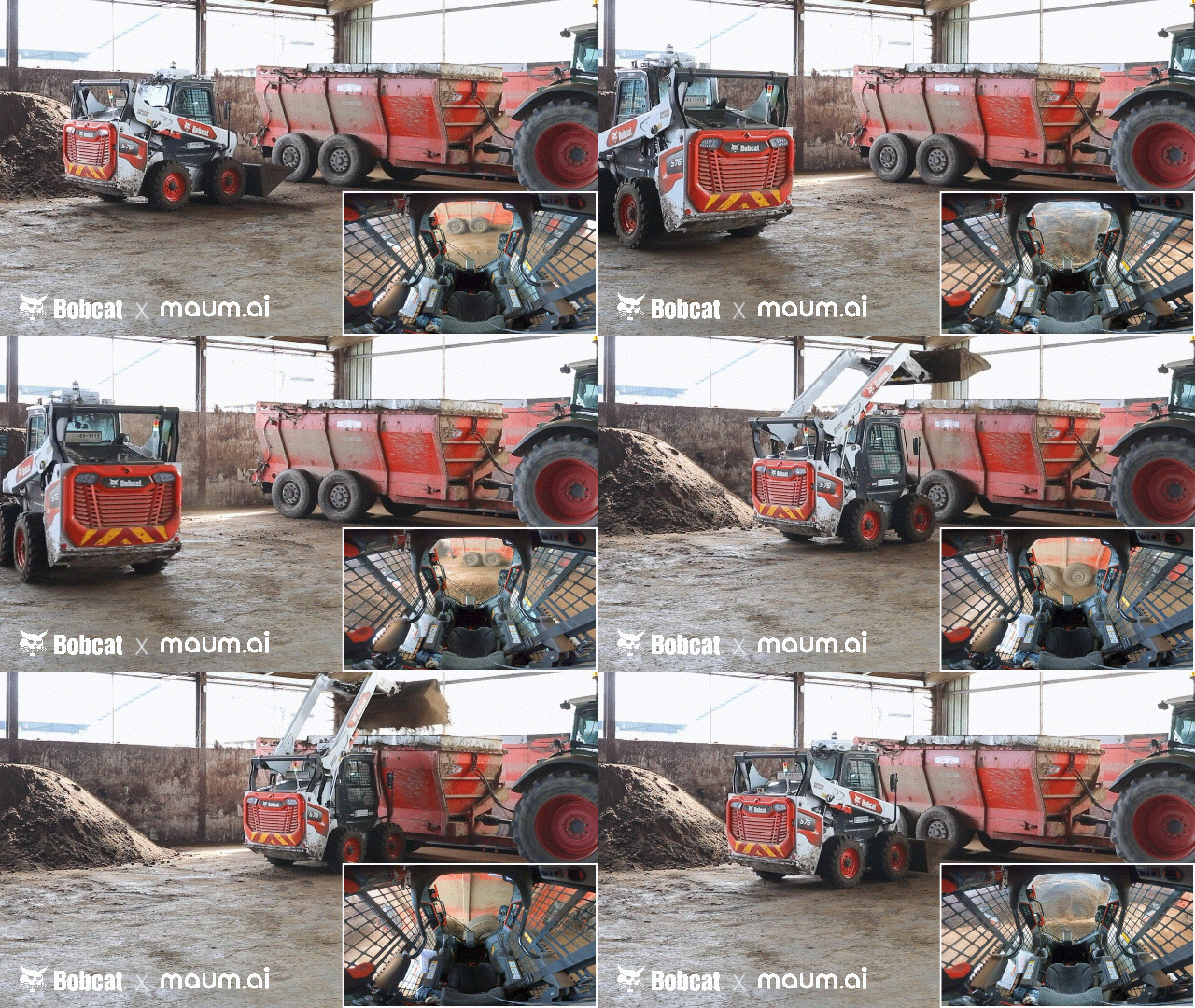
More than 65 years after inventing the world’s first skid-steer loader to clean livestock barns, Bobcat brings its innovation story full circle with a successful field demonstration of
AI-powered autonomous manure handling.
Bobcat has successfully demonstrated the autonomous operation of a Bobcat S76 skid-steer loader in a livestock barn, in collaboration with Korean AI solutions company, MAUM.AI. Powered by Vision-Language-Action (VLA)-based artificial intelligence, the machine independently handled manure without operator intervention, marking an important milestone in the development of autonomous construction equipment.
The AI-based technology uses cameras and other sensors to perceive the surrounding environment, understand the work situation and translate this understanding into the machine’s movements. Unlike conventional automation, which relies on preset rules or human commands, it can recognize its working environment, make decisions and act accordingly.
Bobcat selected manure handling in livestock barns as its first demonstration task, as livestock farms face chronic labour shortages driven by rural depopulation. The demonstration follows a memorandum of understanding (MOU) signed by the two companies in early June. In just five months, they progressed from initial technology validation to successfully demonstrating autonomous operation in a real working environment.
In the first demonstration, the Bobcat S76 skid-steer loader autonomously and repeatedly performed a series of tasks: scooping manure into its bucket, transporting it to a designated location and dumping it into a trailer approximately 2.4 metres high.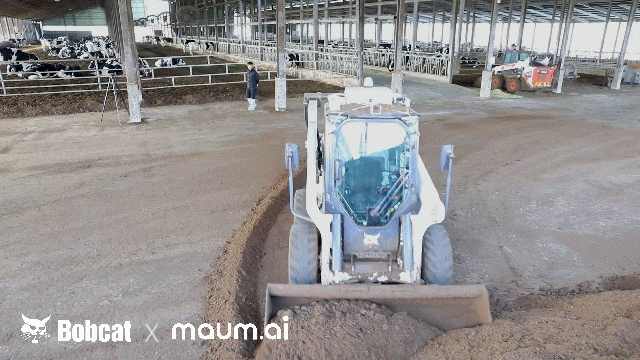
In the second demonstration, the loader recognized manure spread across the floor and independently determined a cleaning path. It then moved forward with the bucket kept as close to the ground as possible, collecting the manure and piling it at a designated location. Both demonstrations were completed successfully without operator intervention.
Charlie Park, Executive Vice President and Chief Strategy Officer of Doosan Bobcat, said, “This demonstration is the first fruit of the technology validation the two companies have carried out together since June. We will expand collaboration among our global R&D teams and with diverse partners to advance autonomous operation and unmanned technologies, and develop them into practical solutions that improve customers’ productivity and work efficiency.”
“By optimizing MAUM.AI’s proprietary Physical AI model for livestock-barn conditions, we achieved a precise construction equipment control and enhanced autonomous performance. The successful demonstration of autonomous manure handling—a labour-intensive task that workers often avoid—shows Physical AI’s potential to solve real-world challenges across industrial worksites,” said Chris Choi, Chief Technology Officer of MAUM.AI.
Bobcat plans to develop autonomous operation scenarios for simple, repetitive tasks as well as jobs that are difficult or burdensome for people. These applications will span industrial environments including livestock farming, agriculture, landscaping and construction, with the aim of broadening the technology’s scope of application.
The achievement has a special connection to Bobcat’s history. In 1958, a Minnesota turkey farmer approached brothers, Louis and Cyril Keller, with a challenge: cleaning livestock barns was dirty, physically demanding work, and existing machinery could not do the job efficiently. Their solution was a compact, manoeuvrable loader capable of scooping up manure in confined spaces. That invention laid the foundations for the Bobcat brand and helped create an entirely new industry.
