

What happens before the truck arrives determines whether recycling works
By Edith Leeuta, CEO, Fibre Circle
For decades, the conversation about South Africa’s waste problem has centred on infrastructure: more landfill sites, better collection systems, improved processing facilities. That framing made sense when the constraint appeared to be capacity, and the assumption was that building more would ease the pressure. The trouble is that South Africa is discovering, somewhat urgently, that building more is no longer an option. Major cities like Johannesburg and Cape Town have less than five years of remaining landfill capacity, and the question has shifted from where to put the waste to how much of it can be kept out of landfill in the first place.
That is a fundamentally different question, and it points to a part of the recycling conversation that receives less attention than it deserves. Because the constraint is no longer only infrastructure. A significant part of the answer lies in a decision that happens before any collection truck arrives, before any sorting facility processes a single bag, before any recycling plant turns waste into something useful. It happens at home, at the office, at school, in the moment when someone decides where something goes.
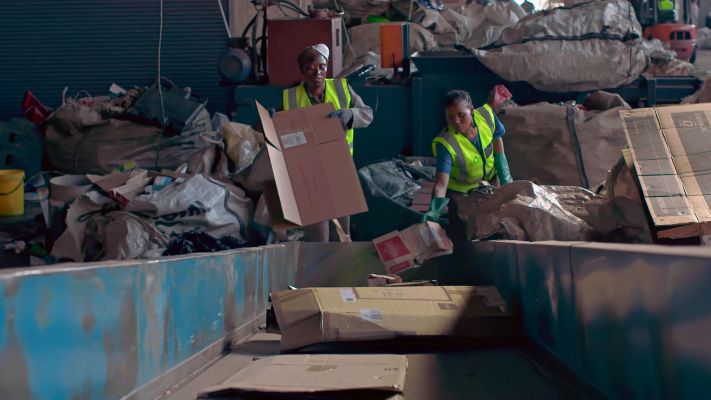
Paper and paper packaging that is kept separate from food waste and liquids can be collected, processed and returned to the economy as new material, becoming a new box, a new carton, a new roll of board. That process supports a recycling value chain that employs tens of thousands of people across South Africa, from the reclaimers who move through residential streets before dawn to the small recycling businesses operating in townships and peri-urban areas where formal employment is scarce. South Africa recycles 70.8% of its paper, a result that reflects real investment and real work across that entire chain.
The same paper, once mixed with food waste or wet material, cannot be recovered. Research has shown that contamination at source is responsible for significant losses of recyclable material that is rendered unrecoverable before it ever reaches a collection point or facility, going to landfill not because the collection system failed, not because the recycling infrastructure was insufficient, but because the decision at the point of disposal made recovery impossible.
This is not a small problem, and it is not an infrastructure problem. It is a behaviour problem, and behaviour problems require a different kind of response. They require education, repetition and the kind of clear, consistent messaging that reaches people where they actually are rather than where recycling advocates wish they were. They require an honest conversation about why separation at source is difficult, what makes it easier and what is actually at stake when it does not happen, because the stakes are not abstract. South Africa cannot build enough new landfill capacity to accommodate its waste at current rates, and the cities that are running out of space are managing the consequence of decades of consumption patterns that treated disposal as someone else’s problem. Reversing that requires a shift in how South Africans understand their relationship to what they throw away, and specifically to what can still come back if it is given the chance.
Paper is one of the most recoverable materials in the waste stream, and also one of the most vulnerable to contamination. A piece of cardboard soaked with food waste has lost its value to the recycling system, while a clean, dry carton separated at the point of disposal has not. The difference between those two outcomes is not technology or investment but a decision that takes a few seconds and costs nothing, and yet it determines whether the material ever returns to productive use or disappears permanently into a landfill that is already running out of room.
South Africa’s waste challenge will not be resolved by any single intervention, and it requires investment in infrastructure, support for the informal recycling economy, stronger producer accountability and more effective municipal systems. But none of those interventions can compensate for the material that is lost before any of them get the chance to work. The recycling system begins where the waste is generated, and that is where the most consequential choices are still being made every day.
