

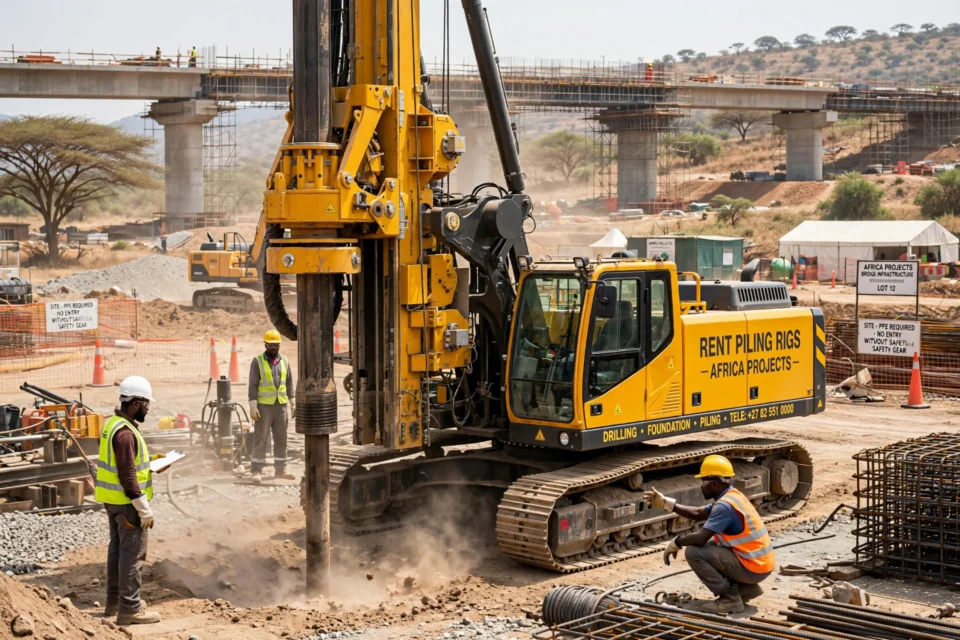
Across Africa, from large-scale transport corridors in East Africa to port expansions in West Africa and mining infrastructure in Africa, a strong foundation remains critical to the safety and longevity of every project. Piling rigs are at the heart of this work, yet for many contractors, purchasing such highly specialised equipment outright is not always viable.
With tight project timelines, diverse ground conditions, and fluctuating demand, equipment rental has become a strategic model for contractors across the continent to access the right piling rig without the heavy capital burden and long-term liabilities of ownership.
Why Renting Piling Rigs Makes Business Sense in Africa
Foundation requirements in Africa vary widely – from piled foundations for bridges along the LAPSSET Corridor, to deep foundations for high-rise developments in Nairobi, Lagos and Johannesburg, and marine piling for port projects in Mombasa, Dar es Salaam and Tema.
Renting offers distinct advantages in this dynamic market:
- Application-Specific Deployment: Rent the rig that matches the exact job – whether it’s CFA, rotary bored, or driven piling – for the specific soil and project duration, rather than adapting an owned machine.
- Optimized Capital Expenditure: Renting eliminates large upfront investment, import duties, depreciation, and long-term storage costs – a major benefit for SMEs and contractors working on donor-funded or project-based contracts.
- Reduced Ownership Burden: Costs related to maintenance, spare parts sourcing, technical crew training, and equipment obsolescence are significantly reduced under a rental model, with support often provided by the rental partner.
- Fleet Flexibility for Multi-Site Operations: For contractors managing simultaneous projects across different countries or geologies – from lateritic soils to hard rock – access to a diverse rental fleet ensures the right capacity is always available.
How to Choose the Right Piling Rig for Your Project in Africa
Selecting the correct rig requires a thorough assessment of engineering needs and local site realities. Consider these key factors:
- Pile Specifications: Define your required pile diameter, depth, and load-bearing capacity. This will determine whether you need a low-headroom rig for urban sites or a high-torque rig for deep infrastructure piles.
- Ground Conditions: African geologies are highly variable – from soft alluvial clays in coastal regions to hard granite and weathered rock in the interior. A detailed geotechnical survey is essential to select rigs with adequate torque, crowd force and tooling.
- Site Constraints: Evaluate access roads, working platform size, overhead restrictions in built-up areas, and terrain stability, especially for remote mining or energy projects.
- Performance and Project Schedule: Align machine productivity with your piling schedule. Consider daily pile output, fuel efficiency, and mobilization time to keep large-scale projects on track.
- Machine Specifications and Tooling: Check rotary torque, engine power, mast height, operating weight, and compatibility with augers, buckets and hammers for your chosen piling method.
- Local Technical Support and Availability: In Africa, after-sales service is critical. Partner with rental companies that guarantee equipment availability, provide on-site operators, and offer rapid technical support and spare parts to avoid costly downtime.
For contractors looking to scale efficiently while managing risk, renting piling rigs from a reputable African equipment partner offers a smarter, more flexible path to delivering solid foundations – without tying up capital.
